Benin, a nation in West Africa, has maintained its democratic institutions despite being situated in a region frequently referred to as 'the coup belt' due to a series of military takeovers since 2020. This democratic resilience contrasts with a period in its history when military dictator Mathieu Kérékou outlawed the practice of 'sorcerers', whom he regarded as subversive elements within the country. While Benin is now seen as a bastion of democracy, its past included periods of authoritarian rule which impacted traditional practices. The nation's steadfast adherence to democratic principles distinguishes it in a geopolitical landscape marked by instability, with Benin described as a bastion of democracy in a region dubbed 'the coup belt' for military takeovers since 2020. This enduring commitment to democratic governance is particularly noteworthy given the historical suppression of indigenous spiritual traditions under previous regimes.
Dictatorship and Suppression
Mathieu Kérékou seized power in a 1972 coup as a major in the military of Dahomey, the former name for Benin. His regime established a Marxist-Leninist dictatorship, which later faced significant economic challenges. Kérékou's ascent to power marked the beginning of a period characterized by a radical shift in the nation's political and social fabric. As a major in the military of Dahomey, Kérékou's 1972 coup d'état ushered in an era of centralized control and ideological adherence to Marxism-Leninism, profoundly reshaping the country's governance and societal norms.
Toward the end of the Cold War, the nationalization of state enterprises under Kérékou's leadership contributed to an economic collapse. This economic downturn was a critical factor in the eventual pressure for political reform. During this period, Voodoo, known locally as Vodún, was viewed by Kérékou as a backward practice. The military dictator Mathieu Kérékou banned the practice of 'sorcerers' whom he deemed subversive, viewing them as a threat to his regime's authority and ideological purity. This perception led to the detention of Voodoo priests and the destruction or loss of numerous shrines, as the state actively sought to eradicate what it considered superstitious and anti-modern beliefs. The suppression of Vodún was a deliberate policy under Kérékou's Marxist-Leninist dictatorship, aiming to replace traditional spiritual practices with a secular, state-controlled ideology. Voodoo (Vodún) was considered backward by Kérékou, leading to detentions of priests and loss of shrines across the country.
Reports indicated that Kérékou was known among his people as "the chameleon" due to his shifting religious affiliations throughout his career. This nickname reflected his pragmatic and often contradictory approach to religion, which evolved significantly over his long political life. Despite his earlier suppression of Vodún, Kérékou later supported the establishment of the National Voodoo Board, marking a profound shift in his approach to the traditional religion. This later embrace of Vodún demonstrated a remarkable transformation in his stance, moving from active suppression to official recognition and support. The country has since seen changes in leadership, with President Romuald Wadagni inaugurated on May 24, succeeding Patrice Talon. This transition shows Benin's continued commitment to democratic processes and peaceful transfers of power, a stark contrast to the authoritarian period under Kérékou.
Democratic Transition and Revival
Benin's democratic transition began with the National Conference of 1990, which pressured for significant political change. This key conference brought together diverse elements of Beninese society, including opposition figures, civil society representatives, and Kérékou's own government, to chart a new course for the nation. The National Conference of 1990 is widely regarded as a landmark event in African democratic history, demonstrating how internal pressure could lead to the dismantling of authoritarian rule. This conference led to Mathieu Kérékou, then a military dictator, organizing an election he subsequently lost in 1991. Democracy came to Benin in 1991 when Mathieu Kérékou, the military dictator, lost an election he organized, marking the first time a sitting president was voted out of power in West Africa.
Nicéphore Soglo, an opposition figure, defeated Kérékou, marking the first instance in West Africa where a sitting president was voted out of power. Soglo's administration then moved to rehabilitate Voodoo, recognizing it as a national heritage. Nicéphore Soglo, the opposition figure who defeated Kérékou, rehabilitated Voodoo as national heritage, officially reversing decades of state-sponsored suppression and acknowledging its deep cultural significance. This act of rehabilitation was a powerful symbol of the new democratic government's commitment to cultural freedom and respect for indigenous traditions.
Kérékou's shifting religious views were noted during this period. Reports indicated he had previously recruited a Malian marabout known as "the Devil" and experimented with other religions, despite his earlier suppression of Voodoo. Kérékou recruited a Malian marabout nicknamed the Devil and experimented with other religions, showcasing his complex and often opportunistic relationship with spirituality throughout his political career. However, by 2001, Kérékou was actively campaigning for the Voodoo vote in Ouidah, demonstrating a complete reversal of his prior stance. This political maneuver noted the religion's enduring influence and its re-emergence as a significant factor in national life. The country further embraced its traditional religion by establishing a festive Voodoo holiday, which has been celebrated annually on January 10 since 1996. A festive Voodoo holiday has been celebrated on Jan. 10 since 1996, solidifying its place in the national calendar and marking a permanent shift in how the state acknowledges and celebrates this deeply rooted cultural practice.
Roots and Significance
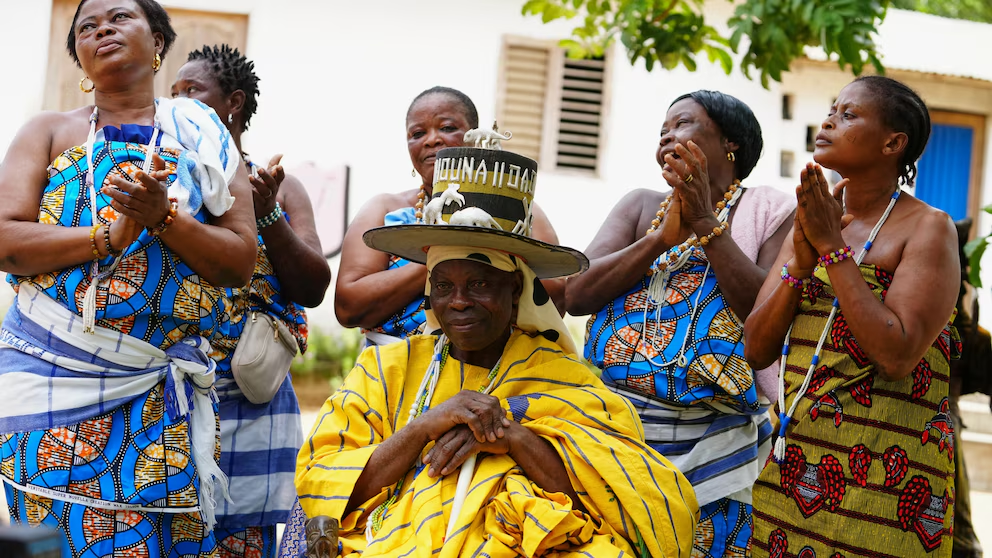
Vodún is "the first religion of all Beninese," according to Mahougnon Kakpo. This assertion shows its foundational role in the country's cultural and spiritual identity, predating and influencing many other belief systems. The traditional religion's supreme leader, Houna II, is based in Ouidah. Houna II, as the Vodún supreme leader, holds significant spiritual authority and plays a key role in preserving and guiding the practices of the religion from his base in Ouidah. Irène Kpatenon, a Vodún devotee, has been observed depositing fruits at a tree stump shrine. Irène Kpatenon, a Vodún devotee, exemplifies the daily acts of faith and devotion that sustain the religion, often involving offerings at sacred sites like tree stump shrines. Ouidah, a city situated on the Gulf of Guinea and a significant slave-trading port, is recognized as the birthplace of Vodún. The birthplace of Vodún is Ouidah, a city on the Gulf of Guinea that was a major slave-trading port, making it a key historical and spiritual center for the religion.
The religion played a critical role in the Bois Caïman pact of 1791, a Vodou ceremony in Haiti where enslaved people reportedly plotted a rebellion. The Bois Caïman pact of 1791 was a Vodou ceremony in Haiti where slaves plotted a rebellion, a testament to the religion's power as a catalyst for resistance and liberation. This key event demonstrates the profound connection between Vodún and struggles for freedom and self-determination. Haiti subsequently became the first free Black republic in 1804. Haiti became the first free Black republic in 1804, a monumental achievement that has been historically linked to the spiritual strength and unity fostered by Vodou among the enslaved population. The 'Door of No Return' monument in Ouidah commemorates victims of the trans-Atlantic slave trade, linking the city directly to this historical context. This monument stands as a poignant reminder of the forced migration that spread Vodún traditions across the Atlantic, embedding its roots in the Americas. Despite its deep roots, roughly half of Benin’s 14 million people identify as Christians, according to the U.S. State Department. This demographic reality notes the religious diversity within Benin, where traditional practices coexist with Abrahamic faiths, reflecting a complex and evolving spiritual landscape.